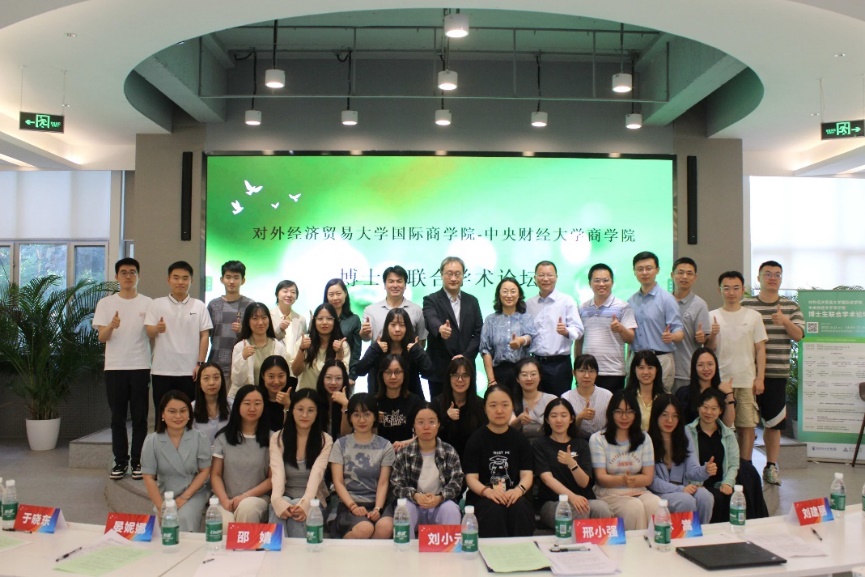
On June 15, 2025, the Joint Doctoral Academic Forum between International Business School of University of International Business and Economics (UIBE) and CUFE Business School was successfully held at UIBE. Doctoral students from CUFE and UIBE conducted in-depth discussions on hot topics such as supply chain digitalization, artificial intelligence, supply chain finance, and digital cultural products. Professor Zhu Jigao, Vice Dean of the School of International Business, UIBE, and Professor Liu Xiaoyuan, Vice Dean of CUFE Business School, co-chaired the forum.
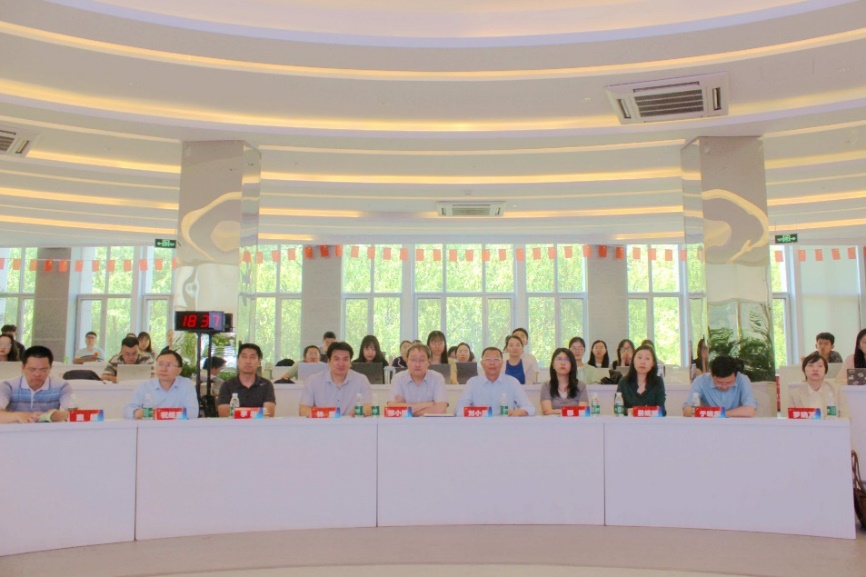
At the beginning of the forum, Professor Xing Xiaoqiang, Dean of International Business School , UIBE, delivered a welcome speech. He stated that he hoped participants could continuously strengthen inter-university cooperation through such forums and gain more inspiration and experience from academic exchanges and dialogues. When delivering a speech, Professor Lin Song, Dean of CUFE Business School and Director of the MBA Education Center, pointed out that the joint organization of this academic forum by CUFE and UIBE is of great significance, as it has built a high-quality and efficient exchange platform for teachers and students of the two universities. In his speech, Vice Dean Li Yan of the Graduate School of UIBE mentioned that inter-university exchanges should be strengthened in the future, and this opportunity should be used to learn from each other and enhance cooperation.
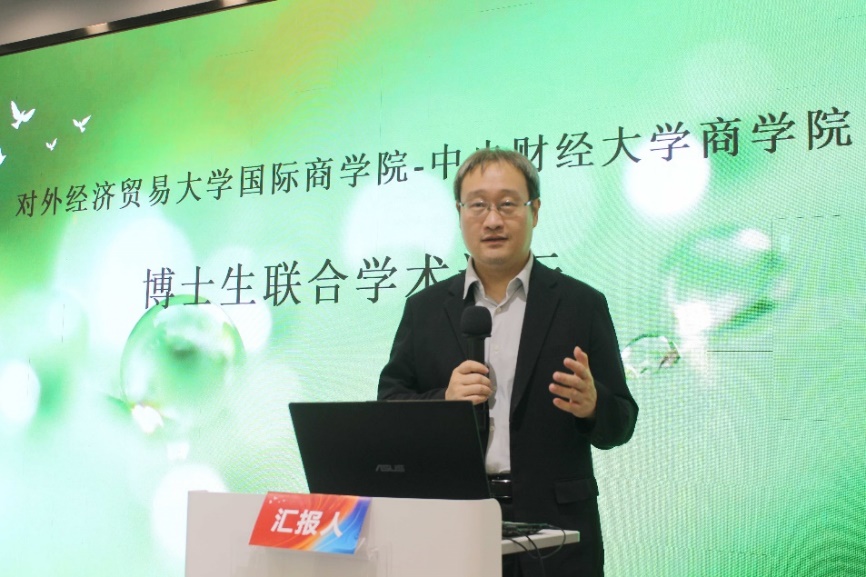
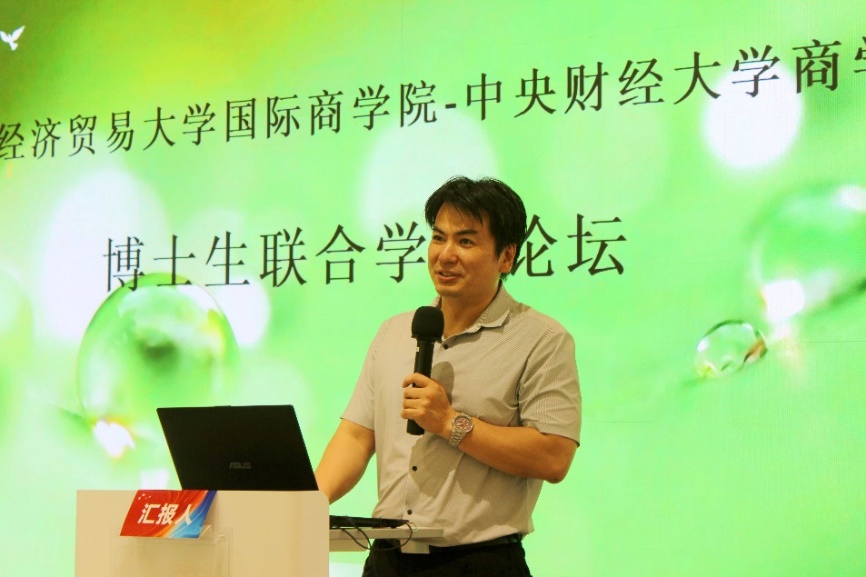
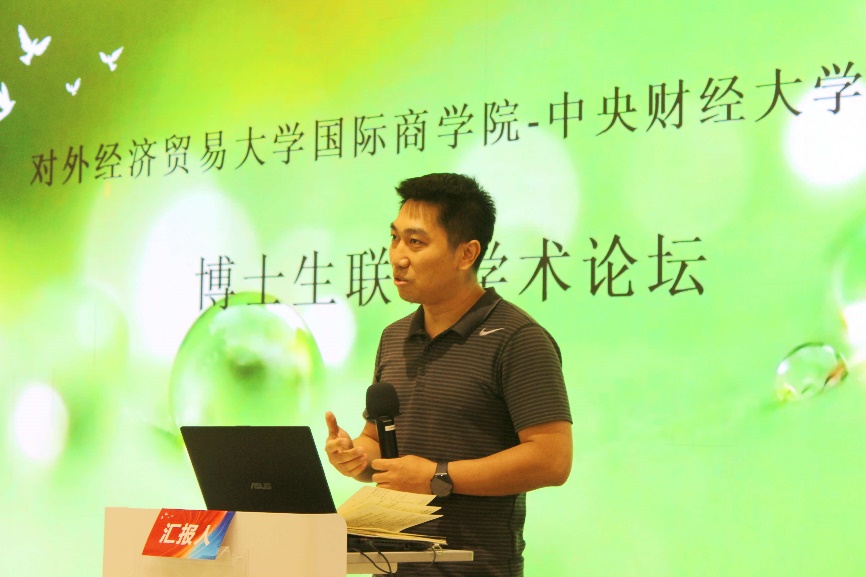
A total of 4 papers were presented at the forum.
Sun Wanlin, a doctoral student from International Business School, UIBE, presented her paper titled "How Does Supply Chain Digitalization Affect Corporate Carbon Emission Intensity? — Empirical Evidence from Chinese Listed Companies". Taking China's supply chain innovation and application pilot policy as a quasi-natural experiment, this paper empirically examines the impact of supply chain digitalization on corporate carbon emission intensity and its mechanism using the difference-in-differences method. The study finds that supply chain digitalization reduces corporate carbon emission intensity through internal innovation empowerment and external information supervision. Professor Yan Nina put forward specific suggestions mainly from the aspects of the paper's framework, the importance of research questions, and mechanism analysis.
Zhong Hechen, a doctoral student from CUFE Business School, gave a presentation titled "Who is the Best Insurance Buyer? Financing the Capital-constrained Manufacturer with Trade Credit Insurance". Through game analysis, this study examines the optimal decisions and profit impact of supply chain participants under two trade credit insurance schemes: trade credit insurance purchased by manufacturers (MI) and trade credit insurance purchased by factors (FI). Teacher Shao Jing provided specific suggestions mainly from the perspectives of research perspective, content depth, and empirical methods.
Guo Jiahui, a doctoral student from International Business School, UIBE, presented her paper "From Corporate Breakthrough to Industry Leadership: How Can AI Application Strategy Orientation Empower?". Focusing on "AI application strategy orientation", this study classifies enterprises' AI applications into "endogenously driven" and "environmentally driven" types, and explores the differential impacts of different strategy orientations on enterprises' achievement of technological breakthroughs at different levels. The study finds that enterprises' "endogenously driven" AI application strategy can significantly promote enterprise-level technological breakthroughs and industry-leading innovations by strengthening scientific dependence and building AI alliances; while enterprises' "environmentally driven" AI application strategy can drive enterprise-level technological breakthroughs, it is not sufficient to incubate industry-leading technologies. Teacher Yu Xiaodong provided relevant suggestions mainly from the aspects of concept definition, theoretical analysis, and empirical testing.
A doctoral student from CUFE Business School presented a paper titled "Familiarity Opens the Door, Novelty Wins the Race: Adaptation of Digital Cultural Products and Its International Performance". Based on the theory of optimal differentiation, this study explores the differential impacts of adaptation strategies on two key product components (name and content) and their effects on international performance. The study finds that name adaptation has a positive impact on overseas market performance, while content adaptation has a negative impact. Teacher Luo Xiaopeng provided reference opinions mainly from the aspects of the paper's framework, theoretical analysis, and endogeneity issues.
The second half of the forum was chaired by Professor Liu Xiaoyuan, Vice Dean of CUFE Business School.
Associate Professor Dou Chao from CUFE Business School shared a topic titled "High-Level Academic Publication and Doctoral Stage Growth: Sharing of Cutting-Edge Methods and Practical Experience". He emphasized that the academic growth during the doctoral stage needs to be built around five core competencies:
Forging independent research capabilities: Establish a two-way interactive model of "proactive consultation - independent decision-making", cultivate research intuition through systematic knowledge management, and dare to think, speak, and practice;
Enhancing organized research capabilities: Seize the opportunity of academic conferences to expand the cooperation network, and master task decomposition and conflict resolution skills in team collaboration;
Strengthening problem-oriented research: Build a "dual-cycle" research model based on Chinese management practice, and capture practical issues by linking with policy trends;
Mastering cutting-edge method tools: Break through the limitations of traditional econometrics;
Promoting interdisciplinary integration: Focus on interdisciplinary research, and stimulate disruptive innovation through interdisciplinary dialogue.
In general, the doctoral stage is the foundation-laying period of academic life, which requires achieving cognitive leap in multi-dimensional tensions and growing into a scholar with both theoretical depth and practical insight.
Professor Liu Jianli, Deputy Editor-in-Chief and Director of the Editorial Department of the journal Economic Management, introduced the journal's characteristics, topic selection directions, and review standards, covering academic hotspots, cutting-edge research, and key issues of focus.
Finally, Vice Dean Liu Xiaoyuan of CUFE Business School made a summary of the forum. He highly praised the academic value and practical significance of this forum, pointing out that the forum not only provides a high-quality academic exchange platform for doctoral students but also offers strong support for the subsequent academic research of participants. He also emphasized that such in-depth inter-university academic dialogues are conducive to promoting interdisciplinary integration and innovative development, further stimulating scientific research vitality, facilitating the sharing and cooperation of academic resources, and injecting new impetus into the cultivation of high-level talents.
The successful holding of this joint doctoral academic forum has created an important opportunity for academic cooperation and exchange between universities. The forum conducted in-depth discussions on practical issues in China's economy, which not only expanded the academic perspective on hot economic issues but also built a long-term cooperative mechanism for inter-university collaborative innovation.