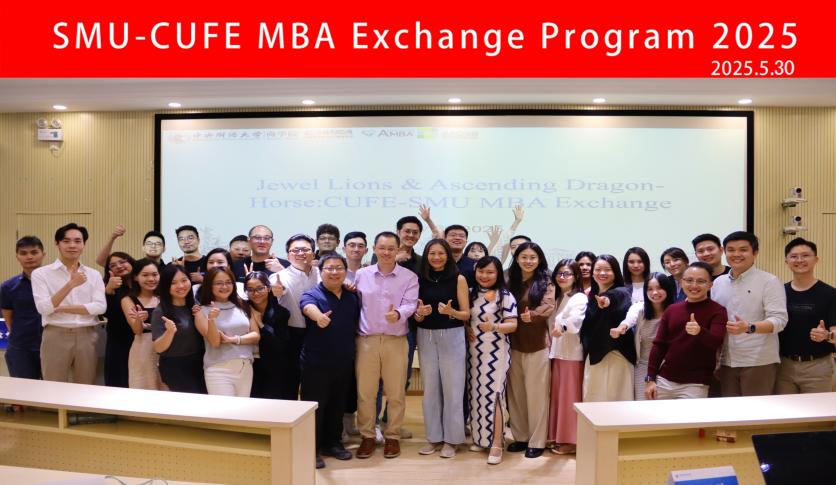
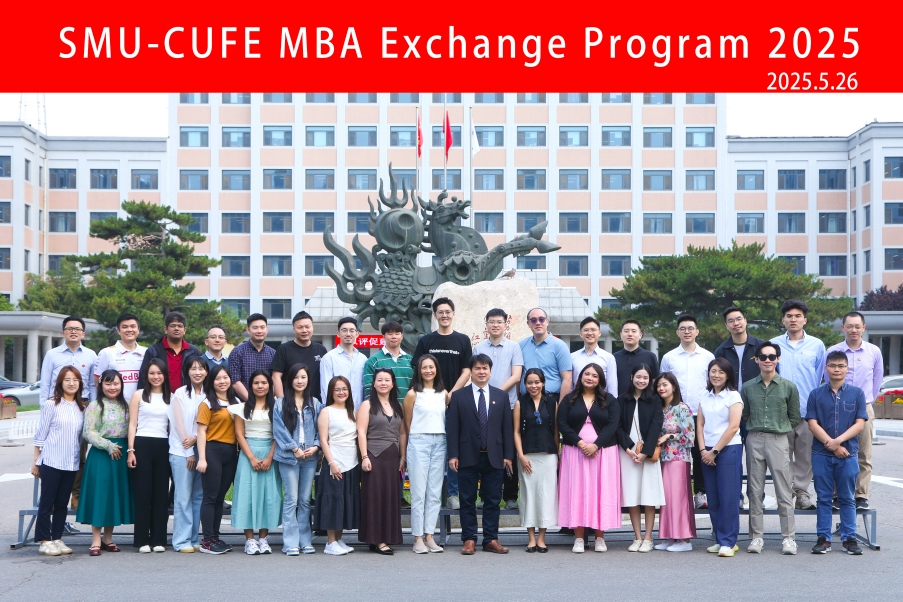
From May 26 to 30, 2025, an MBA student team from the Lee Kong Chian School of Business (LKCSB) at Singapore Management University (SMU), led by Ms. Yeo Lay Yan, Director of the Graduate Office, arrived at Central University of Finance and Economics (CUFE) from across the ocean. Comprising 29 current SMU MBA students from 11 countries, the team kicked off a one-week cross-border academic exchange program centered on the theme of "Digital Economy, Strategy and Innovation".
This event served as an official return visit following CUFE’s themed academic exchange to SMU from September to October 2024, and both institutions attached great importance to it. During the exchange, teachers and students from the two universities joined hands to build a cross-cultural and interdisciplinary platform for ideological interaction through diverse forms such as in-class discussions, on-site enterprise visits, and in-depth cultural exchanges. The program not only focused on cutting-edge topics in the digital economy but also promoted the cultivation of global perspectives and innovative thinking among international business talents through academic exchanges and practical exploration, laying an important foundation for deepening higher education cooperation and academic exchanges between the two sides.
Opening: A Warm Invitation from CUFE, the "Cradle of Finance and Economics"
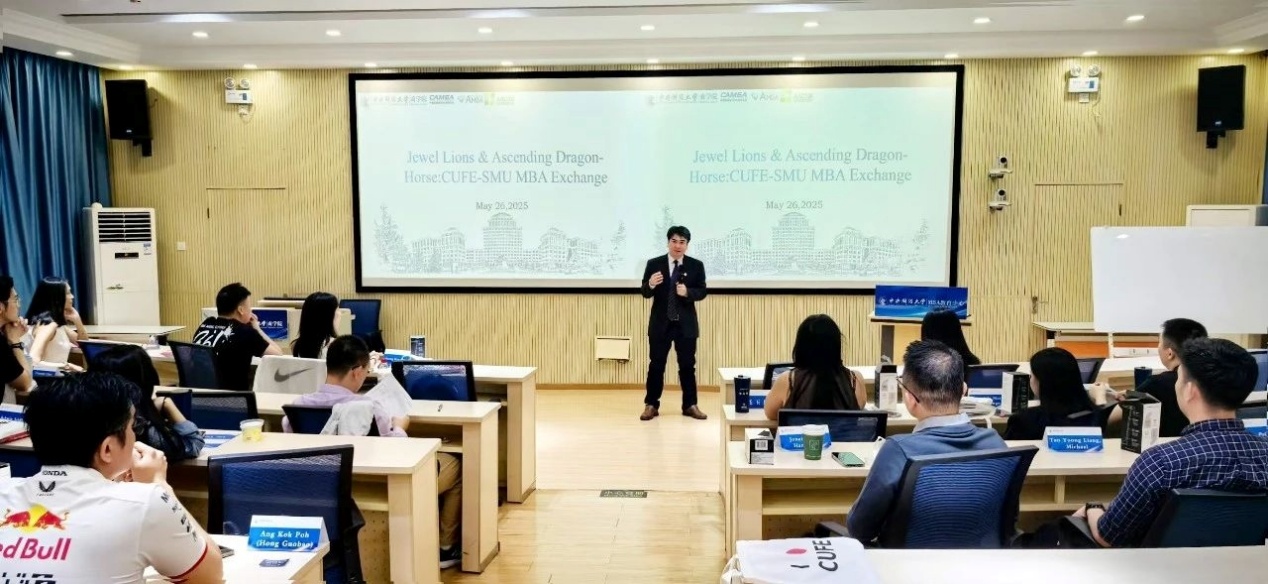
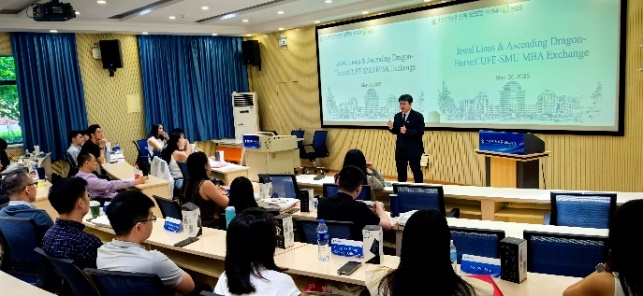
On the morning of May 26, the welcome ceremony kicked off with the theme of "Jewel Lions & Ascending Dragon Horses". In his welcome speech, Professor Lin Song, Dean of CUFE Business School and Director of the MBA Education Center, stated that this exchange was not only a transfer of knowledge but also a dialogue of diverse business wisdom. CUFE MBA has always been committed to cultivating innovative leaders with a global perspective and financial expertise, and he expressed the expectation to explore new management paradigms in the digital economy era together with SMU teachers and students.
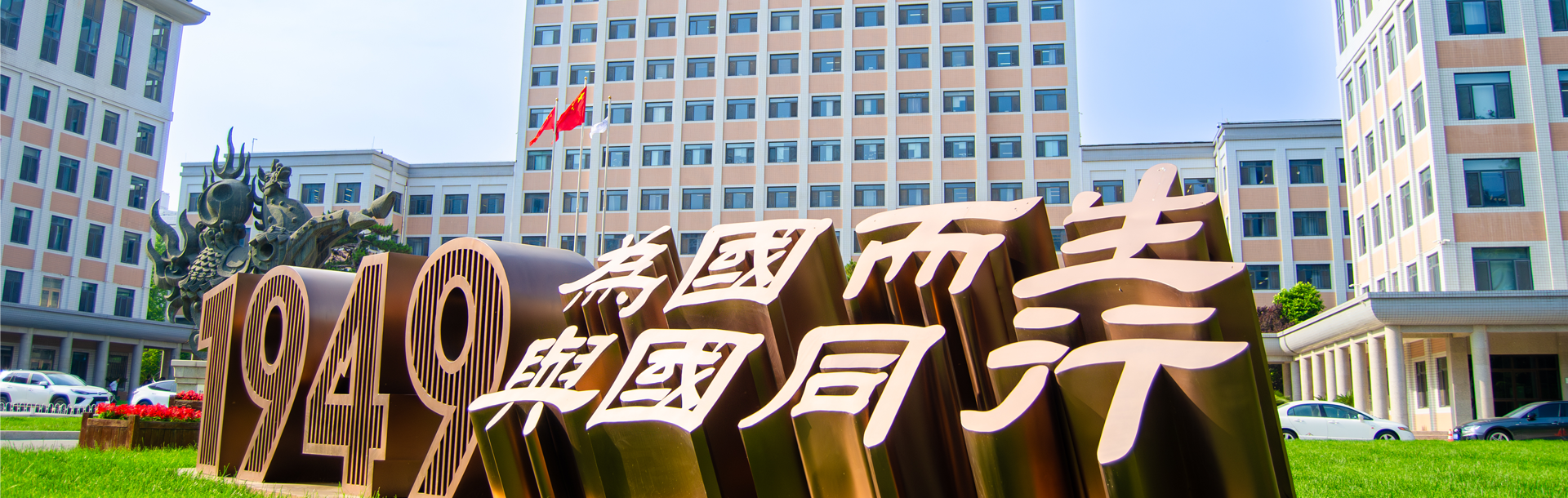
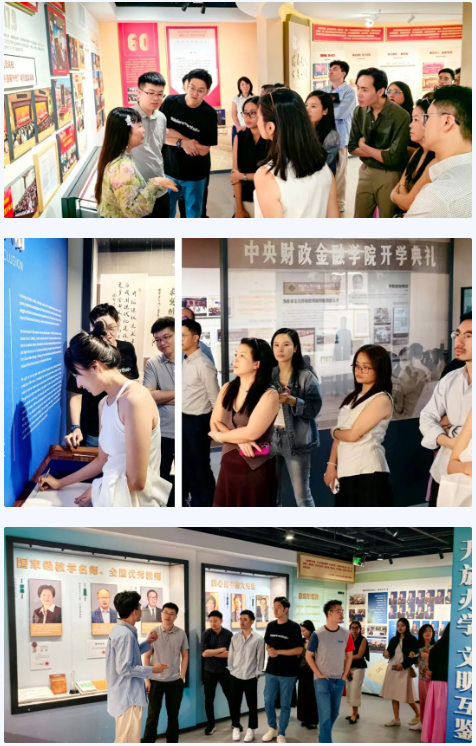
Subsequently, the SMU teacher-student team visited the CUFE History Museum, where they gained insights into the development of China’s finance and economics education through the university’s century-long history. The school-running philosophy of "serving the country and the people through economics" embodied in the museum echoed perfectly with SMU’s educational mission of "innovation, practice, and global perspective", laying an ideological foundation for subsequent exchanges.
Academic Empowerment: Intellectual Inspiration in the Digital Economy
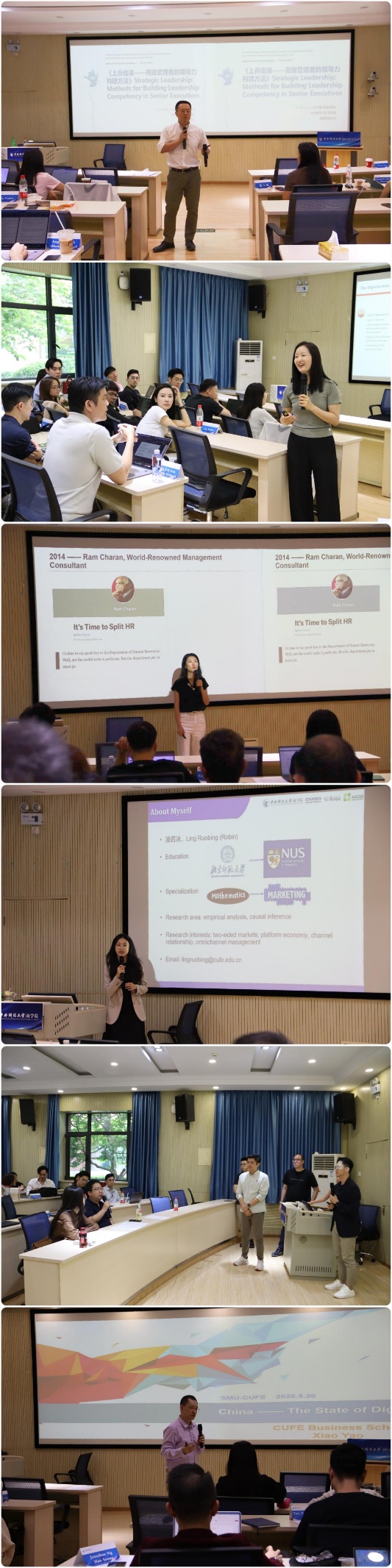
Professor Lin Song opened the academic sessions with his lecture Digital Entrepreneurship Practice in the Chinese Market. He analyzed the growth paths of Chinese internet enterprises, pointing out that digital technology is reshaping business boundaries, and entrepreneurs need to possess both technical sensitivity and the ability to innovate business models. Associate Professor Liu Shubo’s lecture Innovation and Strategic Thinking used a number of enterprises as case studies to explore the relationship between the institutional environment and corporate innovation, triggering students’ reflections on the "balance between globalization and localization".In AI-Driven Business Intelligence, Professor Dai Hongyan combined cases from manufacturing and logistics to analyze how AI reshapes business logic through data, algorithms, and computing power. Taking the intelligent billing system of an internet enterprise as an example, he demonstrated the application of AI in supply chain management. Assistant Professor Ji Yueting’s lecture Digital Human Resource Management discussed how practices such as AI interviews improve the efficiency of talent management.
Assistant Professor Ling Ruobing took the Store Fulfillment Service (SFS) strategy as an entry point and used retailer data to demonstrate the impact of omnichannel integration on consumer behavior, emphasizing that marketing must keep pace with technological iteration. Teacher Yao Xiao focused on The Transformation of China’s Financial Market in the Digital Economy Era. By reviewing the rapid development path of China’s internet economy in recent years and using practical cases of the rapid growth of internet giants such as Taobao, JD.com, and Pinduoduo, he revealed the in-depth influence of the current digital economy.In addition, Associate Professor Mou Shandong and Assistant Professor Ling Ruobing attended the course conclusion ceremony, provided comments and guidance on the presentations of three groups, and conducted in-depth interactive exchanges with students.
Enterprise Visits: Experiencing the Pulse of Chinese Business
Visit to Sinosoft Technology
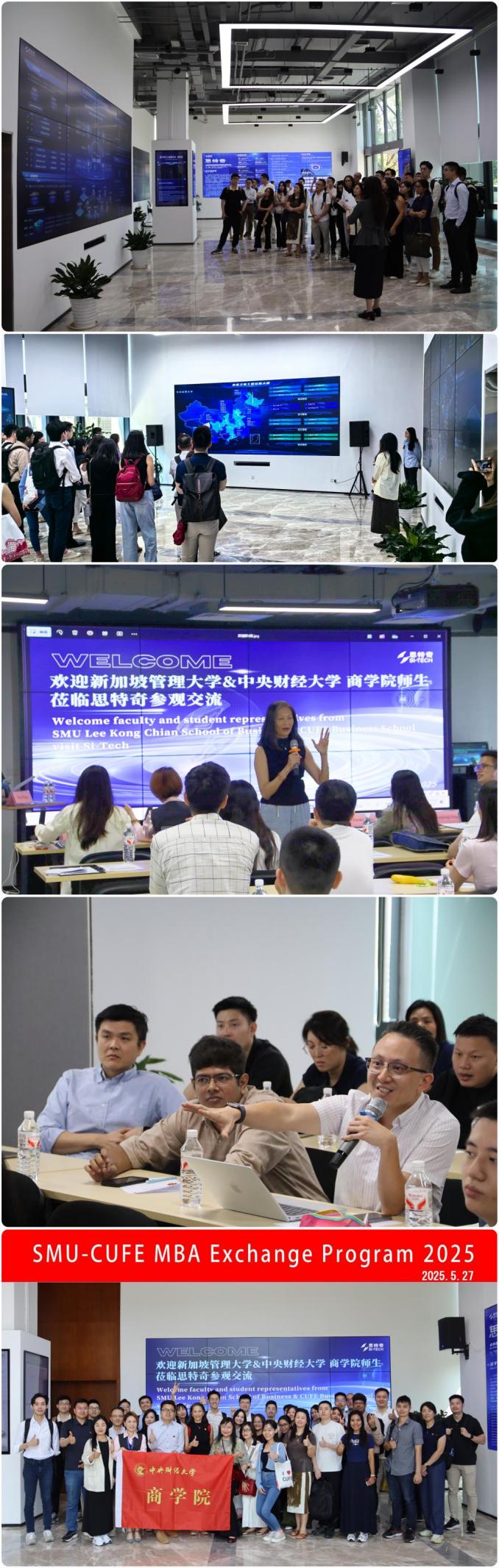
At Beijing Sinosoft Technology Co., Ltd., the teacher-student team gained an in-depth understanding of how ICT infrastructure supports 5G business operations and intelligent marketing. The company’s demonstration of dynamic billing systems and cloud-native technology solutions allowed students to intuitively experience the practical experience of Chinese technology enterprises in digital transformation.
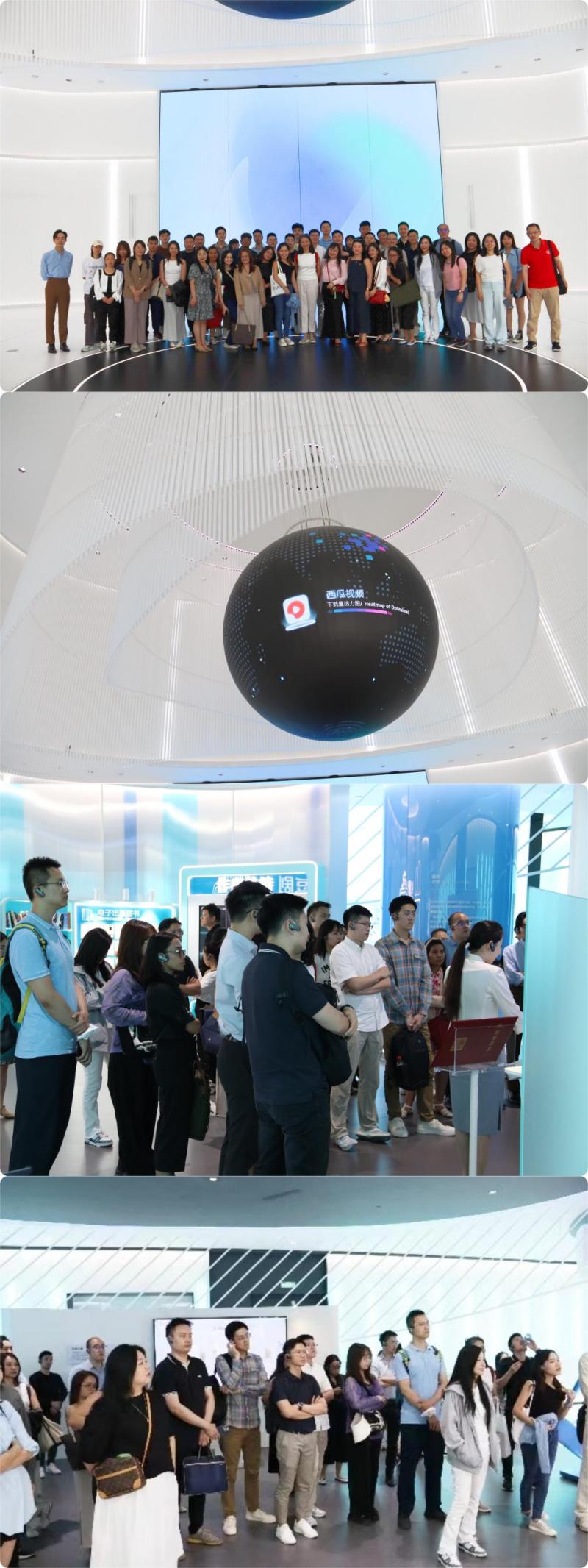
Visit to ByteDance Headquarters
At Beijing ByteDance Technology Co., Ltd., the team focused on discussions about ByteDance’s global ecosystem, the recommendation algorithm logic of Douyin (TikTok’s Chinese counterpart), and the personalized information distribution mechanism of Toutiao. As the company’s representative explained, the core of technological globalization is localized innovation, and the differences in TikTok’s operation strategies across different markets are the best examples of data-driven decision-making – a concept that aligns perfectly with SMU’s "glocalization" (global thinking with local action) teaching philosophy.
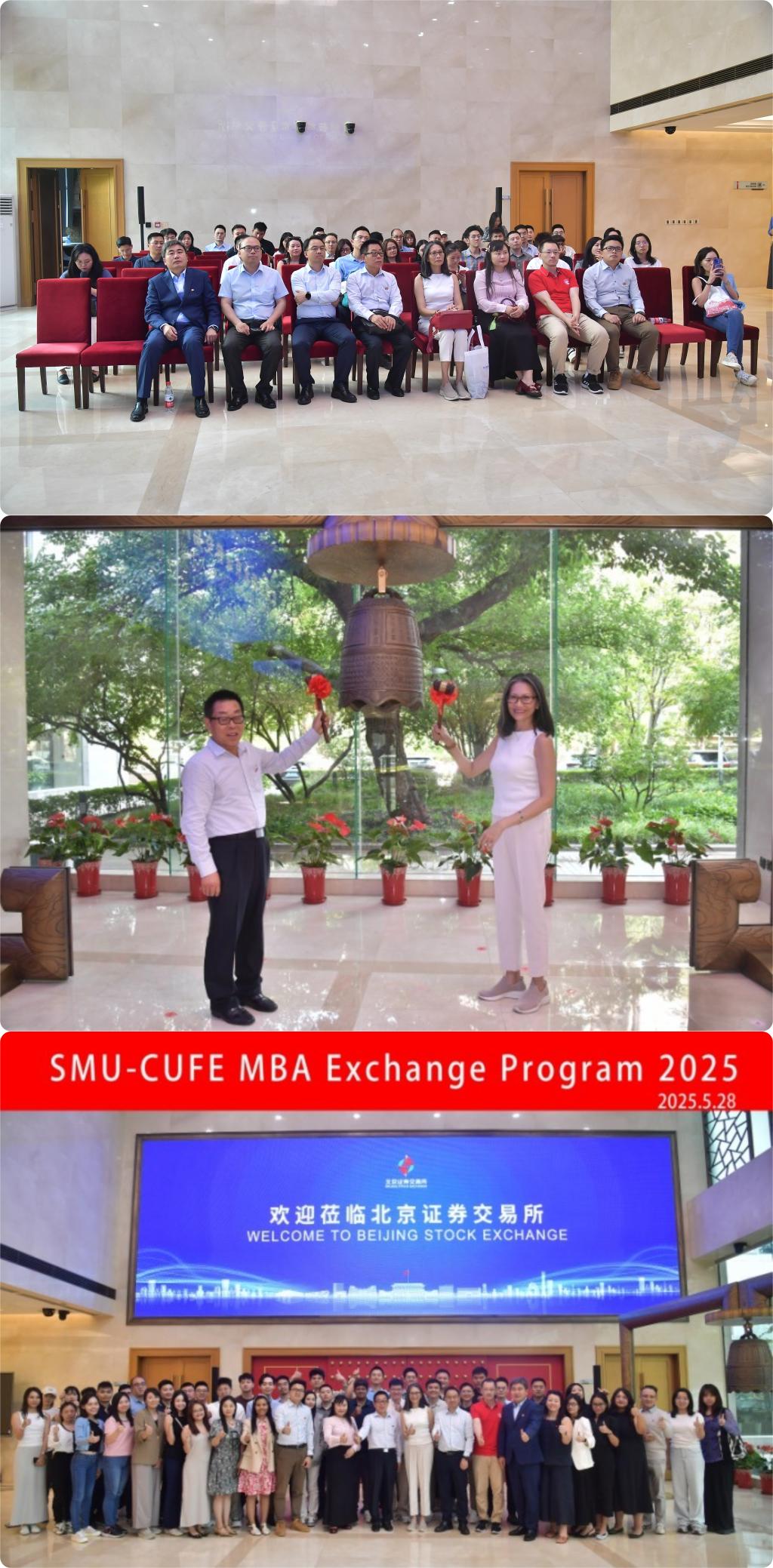
Visit to Beijing Stock Exchange (BSE) and Financial Street Center
As one of China’s three major stock exchanges, the Beijing Stock Exchange was an important stop on the team’s itinerary. During the visit, the team learned first-hand about the support mechanisms of China’s multi-level capital market for innovative small and medium-sized enterprises, such as the 30% price fluctuation limit and market-making system, which are designed to provide a more flexible financing environment for "specialized, refined, characteristic, and innovative" enterprises. The professional interpretation by BSE representatives gave students a fresh understanding of the innovation and inclusiveness of China’s capital market. During the visit, team members also had the honor to experience the market opening bell-ringing ceremony, personally feeling the vigorous vitality of China’s capital market. Later, teachers and students conducted in-depth exchanges with BSE executives to discuss the latest progress of China’s capital market reform and opening-up.
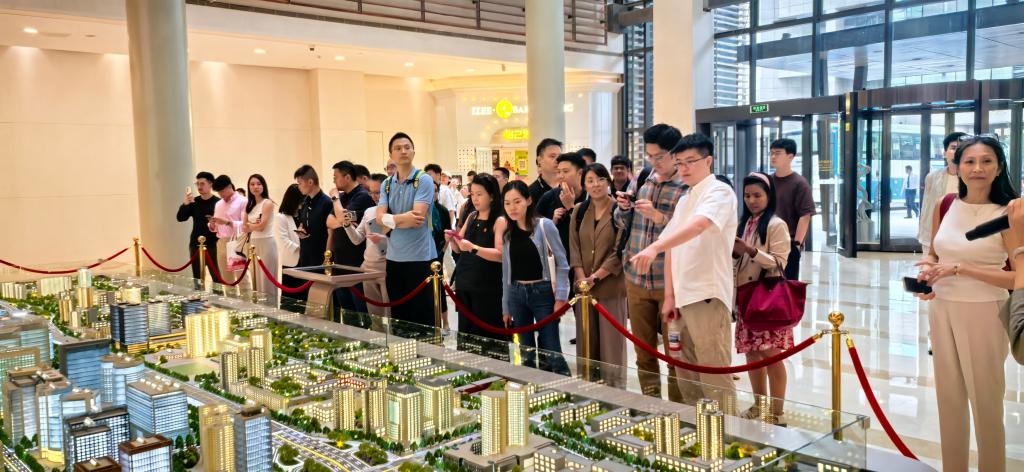
After leaving the BSE, the team also visited the Financial Street Center. Through watching a thematic promotional video and a sand table introduction, they learned about the development history of Beijing’s core financial district.
Conclusion: A Mutual Engagement Between "Dragon Horses" and "Lions"
This exchange program, which brought together participants from diverse cultural backgrounds, not only allowed SMU teachers and students to gain a deep understanding of the "hard strength" of China’s finance and economics education and the "soft charm" of its traditional culture but also achieved the collision and integration of business thinking from different countries through an immersive experience featuring 6 core courses over 5 days and visits to 3 benchmark enterprises (institutions).
The visit of the SMU MBA teacher-student team marked the first official visit by a foreign university since the establishment of CUFE’s GEMBA exchange program, which is of far-reaching significance. The successful implementation of this program has effectively promoted the internationalization of MBA talent cultivation at CUFE Business School, laid a solid foundation for the further advancement of the GEMBA program, and earnestly fulfilled the school’s mission of "contributing new management knowledge and cultivating leaders with a global perspective, innovative spirit, and sense of social responsibility".
Just like the bell-ringing ceremony at the Beijing Stock Exchange – when the sparks of ideas from different cultural backgrounds resonate on the stage of the capital market, they will eventually converge into a powerful force driving business transformation in the wave of the digital economy.